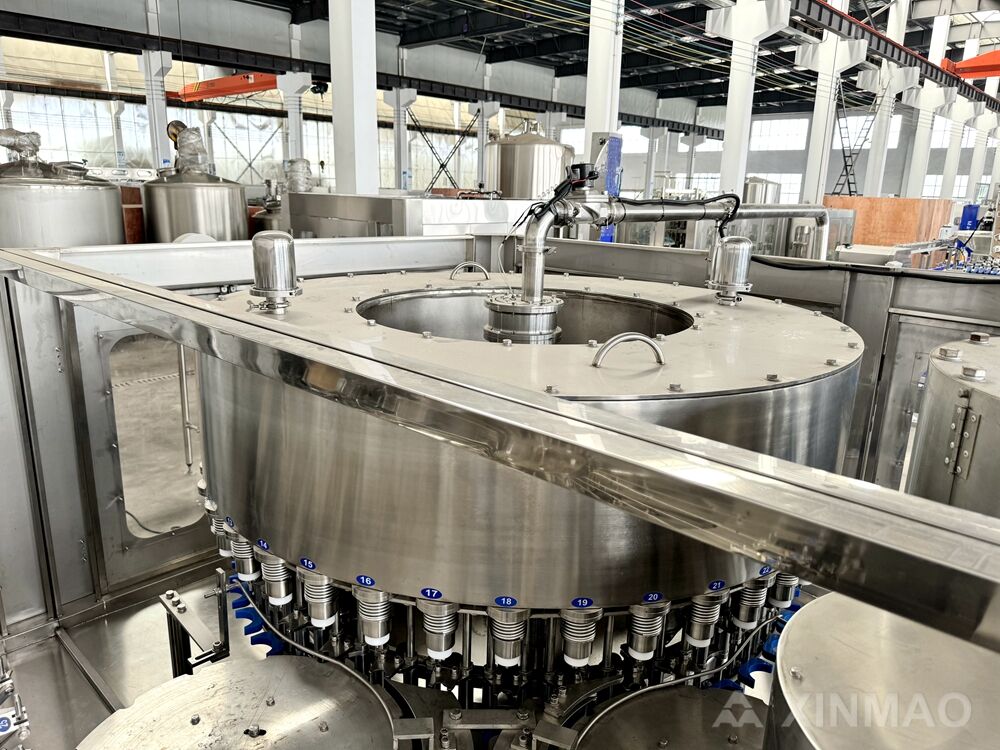
How Water Bottle Filling Machines Work: Core Principles and Operational Logic
Gravity, pressure, and volumetric filling methods explained
Most water bottle filling machines work using one of three main approaches: gravity, pressure, or volumetric filling. The choice between these methods depends largely on what kind of liquid we're dealing with, how fast production needs to be, and whether there are strict regulations about fill accuracy. Gravity filling works simply by letting water flow down into bottles through their natural weight. This method is straightforward, doesn't cost much to operate, and works best for plain water that isn't viscous at all. For carbonated drinks or other sensitive liquids, pressure filling becomes necessary. Machines apply around 0.2 to 0.6 bar of pressure above the liquid surface which helps avoid unwanted foaming while keeping fill levels consistent across batches. Then there's volumetric filling, which probably gets used most often in regulated environments. These systems rely on precise components like calibrated pistons, timed valves, or special metering chambers to measure out exact amounts of liquid. They achieve remarkable accuracy rates between plus or minus 0.5% to 1%, which explains why this approach dominates in facilities subject to FDA 21 CFR Part 129 standards and ISO 22000 requirements for food safety.
Integration with upstream (rinse) and downstream (capping, labeling) stations
The filling machine sits right at the heart of most modern bottling operations these days. Before it comes into play, there are those sterile rinse stations that blast away dirt and microbes using either filtered water jets or food grade air blasts. These stations have been checked off against the latest 3A Sanitary Standards from 2023. After the fill stage, we see servo controlled capping units making sure each closure gets just the right amount of torque whether it's a screw top, snap lid, or press on cap. Meanwhile, label applicators now come equipped with vision systems that double check where labels land in real time. The whole line moves smoothly thanks to conveyor belts working alongside photoelectric sensors and programmable logic controllers keeping everything timed perfectly so no bottles get stuck between stations. All this fancy integration lets plants handle around 20 thousand bottles an hour plus, all while staying within strict HACCP requirements for cleanliness and cutting down on how many times workers need to manually intervene during production.
Choosing the Right Water Bottle Filling Machine by Scale and Output Needs
Selecting the optimal water bottle filling machine requires aligning equipment capabilities with validated production volume, product variability, and long-term scalability—not just peak BPH targets. Bottling operations fall into two distinct tiers, each demanding specific engineering trade-offs between flexibility, automation, and capital efficiency.
Small- to mid-scale plants: Semi-automatic and modular systems (up to 2,000 BPH)
Smaller facilities making around 2,000 bottles per hour or less get the biggest bang for their buck with semi automatic or modular equipment setups. These systems blend hands on bottle loading with automation for cleaning, measuring fills, and sealing caps, allowing quick switches between different types of plastic bottles like PET or HDPE. The price tag is much friendlier compared to full automation options, usually coming in at 40 to 60 percent cheaper. Plus there's less need for expensive supporting infrastructure since these don't require compressed air systems or those complicated cleaning units everyone dreads maintaining. This makes them ideal for test batches, limited edition products, or when meeting those pesky small batch certification requirements regulators love throwing at us. And the adjustable heads mean operators can handle anything from tiny 250ml sample sizes all the way up to 5 liter containers without having to tear everything apart and rebuild just to change sizes.
Large-scale operations: Fully automatic monoblock and linear fillers (2,000–20,000+ BPH)
Big name water companies and contract manufacturing outfits depend heavily on fully automated monoblock or linear filler systems designed to run nonstop around the clock. Monoblock machines combine rinsing, filling, and capping all within one compact unit. This setup cuts down on floor space needed by about thirty percent compared to traditional setups and gets rid of those pesky transfer losses between different stations. Linear systems work differently by spreading out these functions across several parallel workstations. This makes maintenance much simpler since parts can be serviced individually, plus it's easier to hook up with equipment that takes pallets apart before processing or packs finished products into cases afterward. Whether using monoblock or linear designs, these systems typically feature advanced servo motion controls, monitor fill levels in real time through ultrasonic sensors, and meet strict cleaning and sterilization standards required by regulators like the FDA, EU Annex 1 guidelines, and SQF Level 3 certifications. Most modern installations handle over twenty thousand bottles per hour with less than one tenth of a percent variation in fill amounts. Smart factories also benefit from predictive maintenance warnings and operational efficiency dashboards that help track performance metrics day after day.
| Scale Comparison | |
|---|---|
| Output Range | Small/Mid: ≤2,000 BPH • Large: 2,000–20,000+ BPH |
| Automation Level | Semi-automatic • Fully automatic |
| Key Technologies | Modular components • Integrated monoblock/linear systems |
Production volume remains the strongest determinant of system architecture: under 2,000 BPH prioritizes adaptability and compliance agility; above that threshold, industrial automation becomes essential for cost-per-unit stability, audit readiness, and supply chain resilience.
Critical Design and Compliance Factors for Food-Safe Water Production
Sanitary construction: 3A certification, stainless steel (304/316), CIP/SIP compatibility
Producing water that meets food safety standards requires more than just looking clean. The equipment needs to follow strict 3A Sanitary Standards according to SSI guidelines from 2023. These standards specify things like surfaces that are completely smooth without any cracks or crevices where bacteria can hide. Equipment should also be designed so it drains completely, typically needing at least a 2 degree slope. Surfaces need special electropolished finishes with roughness values below 0.8 micrometers to stop biofilms from forming. For parts that come into contact with water during processing, such as fill nozzles, manifolds, and storage tanks, manufacturers use 316L stainless steel because it stands up better against harsh cleaning chemicals and chlorine based sanitizers commonly used in the industry. Most facilities employ automated Clean-in-Place systems that run hot sodium hydroxide solutions between 1.5% and 2.5% concentration at temperatures around 75 to 85 degrees Celsius for at least 15 minutes. After this comes thorough rinsing with sterile water, and many operations will add an extra step using Sterilize-in-Place steam cycles at 121 degrees Celsius when needed. All these processes leave behind detailed records thanks to built-in temperature and flow monitoring systems that meet FDA requirements under 21 CFR Part 11 regulations.
Bottle material flexibility: PET, HDPE, polycarbonate, and custom preform handling
Getting material compatibility right matters a lot in water bottling operations because materials react differently to heat and pressure changes. For PET preforms, maintaining temperatures below 30 degrees Celsius during filling is critical to prevent those annoying white stress marks or dimensional issues. That's why many modern filling lines have chilled conveyor belts and special low torque mandrels that help keep the neck area intact. HDPE bottles need something completely different though they require stronger clamping forces and slower filling speeds to stop them from bulging out. Polycarbonate systems for reuse applications often come equipped with UV-C light sterilization before filling plus closed loop rinse systems that save water and chemicals. The parts that actually touch the containers throughout the process grippers, star wheels, fill heads everything gets special treatment. Engineers design these components with adjustable shapes and soft touch polymer coatings like the FDA approved Santoprene material to prevent tiny scratches where bacteria might hide. Most importantly, the entire preform handling system runs through the plant's PLC control panel. This smart system adjusts parameters like how long each container stays in place, how quickly pressure builds up, and exactly how deep the nozzles go into each bottle based on what kind of container it detects in real time.
Integrated safety protocols—spanning material-specific handling, validated sanitation, and closed-loop process control—ensure every water bottle filling machine delivers not just volume consistency, but verifiable, audit-ready purity from first rinse to final cap seal.
FAQ
What are the main types of filling methods used in water bottle filling machines?
The primary filling methods include gravity, pressure, and volumetric filling, chosen based on the type of liquid, production speed, and fill accuracy requirements.
How do smaller bottling operations benefit from semi-automatic or modular systems?
Small-scale operations benefit from cost-effective semi-automatic or modular systems that provide manual and automated processes, minimizing infrastructure costs and offering flexible production options.
What technologies are employed in large-scale water bottle filling operations?
Large-scale operations use fully automatic systems, such as monoblock or linear fillers, equipped with servo motion controls and real-time fill level monitoring to ensure high-speed, efficient production.
Why is material compatibility important in water bottling?
Material compatibility is crucial to prevent issues like stress marks in PET preforms or bulging in HDPE bottles, ensuring high-quality, safe production.
Table of Contents
- How Water Bottle Filling Machines Work: Core Principles and Operational Logic
- Choosing the Right Water Bottle Filling Machine by Scale and Output Needs
- Critical Design and Compliance Factors for Food-Safe Water Production
-
FAQ
- What are the main types of filling methods used in water bottle filling machines?
- How do smaller bottling operations benefit from semi-automatic or modular systems?
- What technologies are employed in large-scale water bottle filling operations?
- Why is material compatibility important in water bottling?