How to Stop Gazlangan Ichimliklar from Going Flat Between the Filler and the Cap
Gazlangan ichimliklar — the Uzbek term for carbonated drinks, encompassing sparkling water, soda, energy drinks, and carbonated soft drinks — lose their defining characteristic the moment CO₂ escapes from the liquid. The consumer opens a bottle expecting the sharp, tingling sensation of dissolved carbon dioxide, and instead gets a flat, sweet liquid that tastes nothing like the product they paid for. This carbonation loss happens not at the consumer's table but during the 0.8–1.5 seconds between the moment the filling valve closes and the moment the capping head applies the closure — a window so brief that most bottling-plant operators never think about it, yet long enough for 10–15% of dissolved CO₂ to escape from an improperly managed filling system.
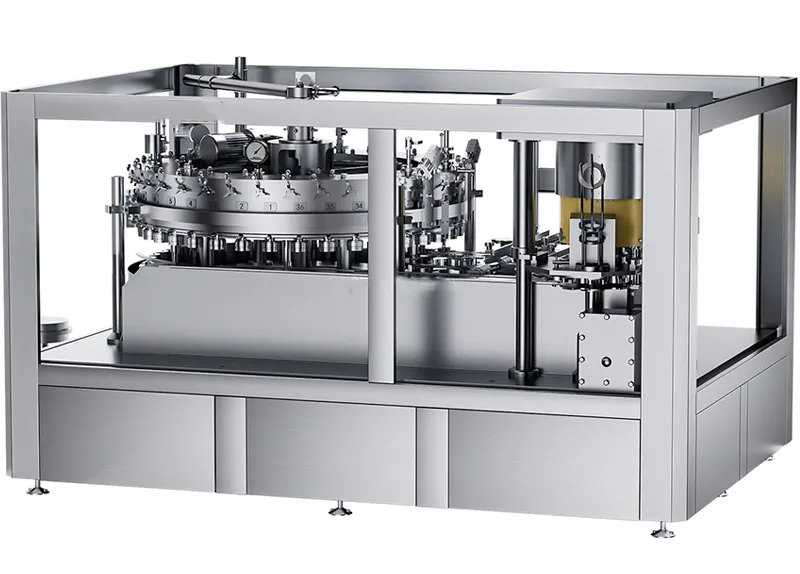
The physics of CO₂ retention in gazlangan ichimliklar follows Henry's Law: the amount of gas dissolved in a liquid is proportional to the partial pressure of that gas above the liquid, and inversely proportional to temperature. At 4°C and 3.5 volumes of CO₂ (a typical carbonation level for cola), the equilibrium pressure inside a sealed bottle is approximately 2.8 bar. If the filling system allows the bottle pressure to drop below 2.8 bar at any point between filling and capping — even for a fraction of a second — CO₂ nucleates into bubbles, the liquid foams, and the fill level drops below the target because foam occupies more volume than liquid. The bottle that reaches the capper is now underfilled and undercarbonated, and the line's reject sensor triggers a waste cycle. Zhangjiagang Xinmao Drink Machinery (Xinmao Machinery) solves this problem with isobaric filling technology on its DCGF-series carbonated-drink filling machines: the bottle is pressurized with CO₂ to match the filler bowl pressure before the filling valve opens, the liquid transfers under pressure equilibrium (no pressure drop, no CO₂ breakout), and the snift valve gently releases headspace pressure after filling to prevent the sudden decompression that causes foam-over. The entire fill-capping sequence maintains CO₂ equilibrium from valve open to cap seal.
The Three Variables That Determine Carbonation Retention
Temperature: Why 4°C Is the Magic Number
CO₂ solubility in water doubles between 20°C and 4°C — meaning a gazlangan ichimliklar product chilled to 2–4°C before filling can hold twice as much dissolved CO₂ at the same pressure as a product filled at ambient temperature. This is why carbonated-drink production lines include a beverage chiller (typically a plate heat exchanger using glycol as the cooling medium) immediately upstream of the filler — the product enters the filler bowl at 2–4°C, the isobaric filling system maintains pressure and temperature through the fill cycle, and the bottle proceeds to capping with minimal CO₂ loss. Xinmao Machinery's carbonated drinks production lines integrate this chilling step as standard, with the chiller capacity matched to the line speed so the filler never receives warm product that would foam uncontrollably.
Real-World Application: A Central Asian Sparkling Water Producer's CO₂ Problem
A sparkling water producer in Uzbekistan bottling gazlangan ichimliklar in 500 ml PET bottles had been using a non-isobaric filling machine — essentially a gravity filler with a pressurized bowl but no bottle pre-pressurization step. The result: CO₂ breakout during filling produced foam that overflowed 8% of bottles before capping, requiring a manual operator to wipe each bottle and reject the underfilled ones. The producer was losing approximately 12,000 liters of product per month to foam-over waste and an estimated 15% of dissolved CO₂ per bottle (the product tasted noticeably flatter than competitor brands in blind taste tests).
Converting to a Xinmao DCGF-series isobaric gazlangan ichimliklar filling line with integrated beverage chilling eliminated the foam-over waste entirely — isobaric filling with bottle pre-pressurization keeps CO₂ in solution from the moment the valve opens until the cap seals. Blind taste tests comparing the Xinmao-filled product against manually bottled samples showed consumers preferred the machine-filled product 8:2 for "carbonation intensity and freshness." The producer's monthly product waste dropped from 12,000 liters to under 500 liters (normal line-start and changeover losses), saving approximately $18,000 per year in recovered product.
Frequently Asked Questions
What CO₂ volumes do different gazlangan ichimliklar require?
Cola: 3.5–4.0 volumes. Lemon-lime soda: 3.0–3.5 volumes. Sparkling water: 2.5–3.0 volumes. Energy drinks: 2.0–2.5 volumes. Fruit-flavored carbonated drinks: 2.0–3.0 volumes. One "volume" of CO₂ means one liter of CO₂ gas dissolved in one liter of liquid at standard temperature and pressure. Xinmao's carbonation systems can be calibrated for any target CO₂ volume.
How does isobaric filling prevent CO₂ loss?
The bottle is pressurized with CO₂ to match the filler bowl pressure (typically 2.5–4.0 bar) before the filling valve opens. The liquid flows into the bottle under pressure equilibrium — no pressure drop occurs, so no CO₂ nucleates into bubbles. After filling, the snift valve gradually vents the headspace pressure to atmospheric over 0.3–0.5 seconds — slow enough that dissolved CO₂ stays in solution.
What bottle materials work best for gazlangan ichimliklar?
PET bottles with CO₂ barrier coating or multi-layer construction. Glass bottles with crown corks or pry-off caps. Aluminum cans with 202/206 end diameters. Each format requires specific filling-valve and capping-head configurations. Xinmao's DCGF-series supports PET, glass, and can formats for carbonated beverages.
How do I test carbonation levels in finished products?
Use a Zahm & Nagel CO₂ volume meter or an Anton Paar CarboQC. Pierce the sealed bottle, measure equilibrium pressure and temperature, and read CO₂ volumes from the instrument's conversion chart. Test one bottle per filler valve every 2 hours during production to detect valve-specific carbonation drift.
What causes inconsistent carbonation between bottles?
Temperature variation in the product entering the filler (chiller malfunction), pressure fluctuation in the filler bowl (CO₂ supply regulator drift), filling-valve seal wear (valve-specific leak causing pressure drop during fill), or capping-head torque variation (insufficient cap seal allowing post-fill CO₂ leakage). Xinmao's PLC-controlled systems monitor and log these parameters for trend analysis.
Can I carbonate juice products?
Yes — carbonated juice drinks (sparkling apple juice, carbonated orange drink) are an established product category. Juice carbonation requires lower CO₂ volumes (1.5–2.5) than cola because juice solids can nucleate CO₂ bubbles more readily than water. The juice must be degassed before carbonation to remove dissolved air that would cause foaming. Xinmao's carbonated drinks production lines include degassing modules for juice-based gazlangan ichimliklar.