The Automation Decision Point
A manual water bottle machine producing 200–500 BPH with two operators versus a fully automatic 3-in-1 monoblock producing 2,000–5,000 BPH with one operator — the throughput difference is obvious. The real question is whether increased output matches market demand and whether capital expenditure recovers through labor savings and consistency improvement.
The most damaging upgrade timing error is upgrading too early. A manual line at 60% capacity because sales have not absorbed current output should not be replaced; the bottleneck is commercial, not mechanical. The correct trigger: sustained operation above 80–85% of capacity for three consecutive months, with order backlog indicating demand exceeding current configuration capability.
A Nigerian bottled water producer operated a manual filling line for 22 months, reaching 85% utilization before ordering an automatic 3,000 BPH monoblock. The delay allowed brand establishment and distributor relationships to develop. The 22 months of sales data provided demand evidence securing favorable equipment financing.
Manual Operation Realities
Process Flow and Labor Scaling
Manual water bottle machine configurations depend on operator-dependent steps: bottle placement beneath nozzles, foot-pedal fill activation, visual fill confirmation, manual cap placement, and transfer to capping. Two operators manage a four-head semi-automatic filler at 300–400 BPH with organized material flow.
Labor cost scales linearly with throughput — doubling output requires doubling operators or adding filling heads plus operators to load them. This linear relationship creates the economic ceiling: at some volume, cumulative labor cost over 24 months exceeds the capital cost of automation that eliminates those positions.
Quality Consistency Gaps
Manual fill level control depends on operator attention. A momentary distraction produces underfill; visual misjudgment produces overfill and product loss. Automatic volumetric or level-sensing systems eliminate this variability through mechanical or electronic measurement rather than human judgment.
Cap torque consistency — critical for seal integrity — varies between manual pressing and the consistent electromagnetic clutch control of automatic capping heads. Distributors receiving inconsistent cap tightness attribute quality problems to the brand, damaging reputation beyond the affected batch.
Automatic Water Bottle Machine Benefits
Integrated Process Control
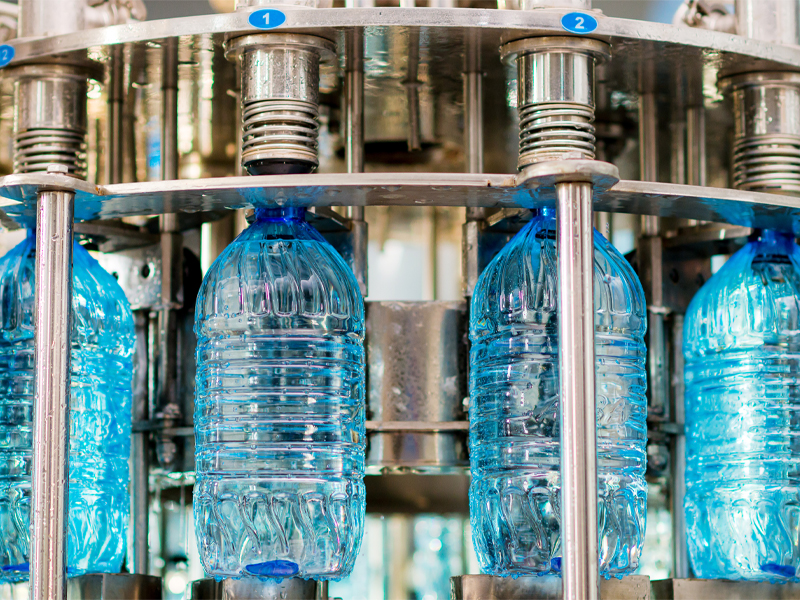
A fully automatic monoblock integrates rinsing, filling, and capping into continuous automated sequence. Bottles enter via conveyor, rotate through rinsing, proceed to filling where automatic valves dispense precise levels, and exit through capping where electromagnetic heads apply consistent torque.
PLC control with Siemens or equivalent industrial controllers provides recipe management — selecting a format from the HMI touchscreen adjusts fill volume, conveyor speed, and cap torque to stored parameters. Format changes taking 15–30 minutes manually complete in 5–10 minutes with servo-driven positioning.
"No bottle no fill" and "no bottle no capping" logic prevents product and cap waste from triggered cycles without bottles present. These safeguards eliminate material losses that manual operations incur through occasional operator error.
Throughput and Labor Economics
A 3,000 BPH automatic monoblock requires one operator — roughly 0.33 operators per 1,000 BPH. A manual four-head producing 400 BPH with two operators requires 5 operators per 1,000 BPH — a 15:1 labor efficiency ratio. At loaded labor costs of 5,000–8,000 annually per operator in developing markets, savings recover automatic machine capital within 18–30 months above 2,000 BPH.
Savings extend beyond filling operators. Automatic unscramblers eliminate manual bottle orientation, automatic labelers eliminate manual application, and automatic shrink wrappers eliminate manual wrapping — compounding direct labor savings through the entire line.
Upgrade Planning
Production Continuity
Bottlers cannot suspend production during upgrades. The transition strategy: run the manual line at maximum capacity for two weeks pre-delivery, building two to three weeks of finished goods inventory. Install the automatic machine while fulfilling orders from inventory, with manual line available as backup.
Xinmao Machinery provides factory pre-assembly reducing on-site installation to 5–10 working days. Supplier installation supervision ensures production readiness within the timeline that pre-built inventory can sustain.
Operator Retention
Manual line operators possess bottle handling knowledge accelerating automatic machine learning. The operator who has loaded 50,000 bottles understands stability dynamics, cap seating feel, and fill level cues complementing sensor-based controls. Retraining these operators as machine tenders preserves intuition while adding HMI and PLC troubleshooting skills.
Frequently Asked Questions
At what volume does manual filling become uneconomical?
The crossover typically occurs at 800–1,200 BPH sustained demand. Below this, manual labor costs remain lower than automatic capital costs. Above it, cumulative labor expense over 24 months exceeds equipment investment.
How many operators does a fully automatic water bottle machine require?
A 3,000–5,000 BPH system requires one operator for monitoring and material replenishment. Higher-speed lines add a packaging operator. Labor scales with packaging complexity rather than filling speed.
What quality improvements come with automation?
Automatic filling delivers level consistency within ±1–2mm versus ±5–8mm manually. Automatic capping applies consistent torque within ±0.3 Nm. Product loss from overfill drops 3–5%, improving material margins.
How long does the transition from manual to automatic take?
Pre-upgrade inventory building: two to three weeks. Installation: 5–10 working days for pre-assembled monoblock. Commissioning and training: 3–5 days. Total transition typically spans four to five weeks.
Can semi-automatic machines serve as a transition step?
Yes. Semi-automatic machines with automatic filling but manual loading bridge fully manual to fully automatic. They increase throughput to 800–1,500 BPH at lower capital investment. Xinmao Machinery offers scalable gravity filling from semi-automatic through fully automatic.
What financing options support machine upgrades?
Supplier payment terms, local bank equipment loans, and leasing arrangements provide financing. Labor savings from automation typically cover financing payments within the first year at volumes above 2,000 BPH.