The Mechanical Distinction
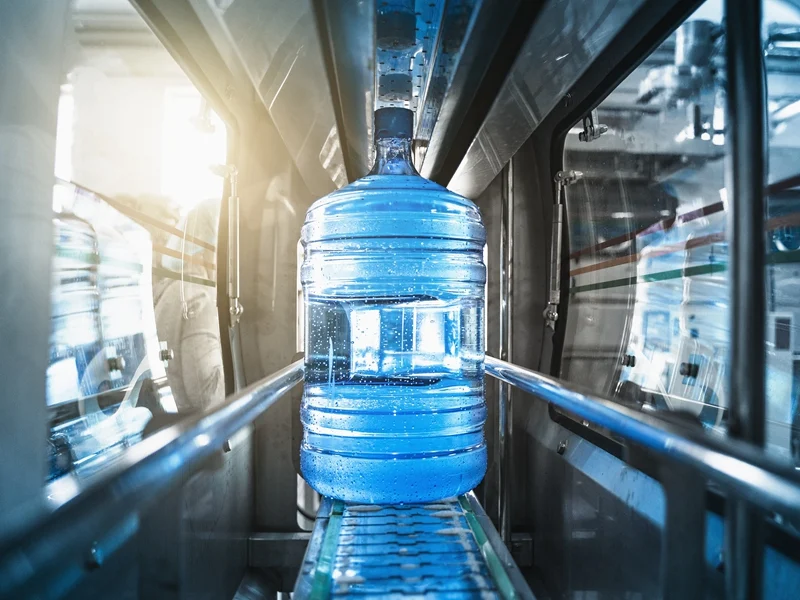
A linear water filling machine moves bottles along a straight conveyor, stopping them at filling stations where valves descend, fill, and retract before indexing the next set. A rotary system mounts valves on a continuously rotating carousel, with bottles entering and exiting through star-wheel transfers without stopping. The difference — intermittent versus continuous motion — determines throughput, floor space, and product type suitability.
Linear systems dominate the sub-5,000 BPH segment where simpler mechanics and lower purchase cost outweigh rotary throughput advantages. Rotary becomes the clear choice above 8,000 BPH, where continuous motion eliminates the acceleration cycles limiting linear machines to roughly 60–70% of theoretical cycle rate due to bottle stability constraints.
A Southeast Asian contract bottler operates both: a 4,500 BPH linear line for frequent bottle format changes on short-run customer orders, and a 24,000 BPH rotary line for a single high-volume SKU running 18 hours daily. The linear line processes 15 different bottle sizes annually; the rotary handles two. The dual-configuration strategy emerged from analyzing changeover frequency rather than volume alone.
Linear Filling Characteristics
Throughput Constraints
Linear water filling machine systems index bottles into position beneath a stationary filling head assembly. Valves — typically 4–24 heads — descend simultaneously, fill, and retract. The conveyor then advances filled bottles toward capping while positioning the next set of empties.
The indexing cycle — stop, fill, start — creates the fundamental constraint. Each cycle accelerates and decelerates bottles without toppling. Taller, narrower bottles with higher centers of gravity tolerate slower indexing. Practical throughput peaks at 6,000–8,000 BPH for 500ml bottles — beyond this range, adding filling heads reduces fill time but does not accelerate mechanical transfer.
Changeover Agility
Linear machines accept format changes through guide rail spacing, filling head height, and conveyor speed adjustments — 15–30 minutes without specialized tools. No star wheels or neck grippers require replacement between formats. This agility explains why bottlers running frequent short batches favor linear configurations despite lower throughput ceilings.
The open-frame design allows visual inspection of every bottle movement, making jam clearing direct and straightforward. Start-ups where operators learn bottle handling dynamics benefit from this accessibility.
Rotary Filling Characteristics
Continuous Motion Throughput
Rotary fillers mount 20–80 valves on a rotating carousel. Bottles enter through a feed star-wheel, engage filling valves through a cam track, fill during 180–270 degrees of rotation, then exit through a discharge star-wheel. The continuous motion achieves 90–95% of theoretical throughput compared to 60–70% for indexed systems.
Throughput scales with turret diameter and valve count. A 50-valve rotary at conservative rotation speed outperforms a 24-head linear at maximum cycle rate. Practical throughput ranges from 3,000 to 36,000+ BPH. Xinmao Machinery's rotary monoblock configurations span this entire range with rinsing-filling-capping 3-in-1 integration.
Bottle Handling Precision
Rotary systems grip bottles at the neck flange during filling, providing positive control rather than relying on conveyor friction. Neck handling eliminates toppling risk during filling and enables higher fill rates. The neck-finish requirement means bottles need consistent dimensions — variable neck dimensions across suppliers require custom gripper sets.
Format changes require star-wheel, guide, and gripper replacements consuming 45–90 minutes. This represents the primary rotary limitation: throughput advantage offset by longer changeovers when running multiple formats.
Selection Framework
Total annual volume determines the primary choice, but three factors often override. Changeover frequency favors linear below 5,000 BPH regardless of volume. Floor space constraints favor monoblock rotary designs. Expansion plans favor linear — duplicating lines adds capacity while preserving initial investment.
Production environment conditions also influence selection. Facilities with high ambient humidity and aggressive washdown procedures expose linear filling head assemblies and electrical components to moisture differently than enclosed rotary designs. The open linear frame simplifies cleaning access but requires more rigorous electrical protection specification. Rotary enclosures provide inherent splash protection at the cost of more complex internal sanitation procedures.
Operational simplicity favors linear where experienced rotary technicians are scarce. The mechanical transparency — visible bottle flow, accessible jam points, intuitive adjustments — reduces specialized training needs. Rotary maintenance for star-wheel timing, cam track adjustment, and valve synchronization requires dedicated technician development.
Frequently Asked Questions
At what volume should a bottler switch from linear to rotary filling?
The transition typically occurs at 5,000–8,000 BPH. Below this, linear provides adequate throughput with simpler operation. Above it, rotary continuous motion achieves efficiency that indexing cannot match. Frequent format changes may justify remaining linear above 8,000 BPH.
How much floor space does a rotary machine require compared to linear?
Monoblock rotary designs occupy 30–40% less floor area than equivalent-throughput linear configurations. A 20,000 BPH rotary monoblock fits within roughly 3 × 5 meters, while comparable linear extends 6–8 meters.
Why do rotary fillers handle bottles by the neck?
Neck handling provides positive bottle control throughout filling, eliminating toppling risk at high speed. The trade-off is requiring consistent neck finish dimensions across bottle suppliers for gripper compatibility.
What maintenance training do rotary machines require?
Star-wheel timing adjustment, valve disassembly and seal replacement, cam track wear inspection, and PLC troubleshooting constitute core skills. Xinmao Machinery provides installation supervision and operator training covering routine maintenance procedures and parts replacement intervals.
Can linear filling machines be upgraded to higher throughput?
Linear throughput increases face indexing mechanism constraints. Minor improvements through additional filling heads are possible, but doubling capacity typically requires a second line rather than in-place upgrades.
Which configuration handles format changes faster?
Linear machines complete changes in 15–30 minutes through guide rail and head height adjustments. Rotary requires star-wheel, guide, and gripper changes consuming 45–90 minutes. Bottlers running frequent changes should evaluate whether rotary throughput justifies accumulated downtime.