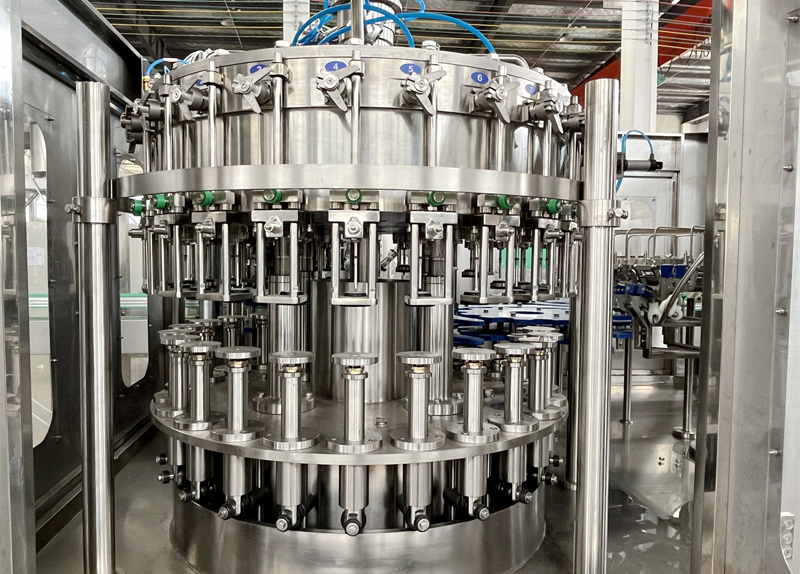
Why High Viscosity Challenges Standard Soft Drink Filling Machines
Accuracy loss, inconsistent fill volumes, and cycle time delays
Standard soft drink filling machines rely on gravity or overflow methods—designed for low-viscosity liquids like carbonated water or cola. When applied to high-viscosity products such as fruit nectars or pulp-rich smoothies, these systems struggle fundamentally. Thick liquids flow slowly and unevenly, causing delayed, incomplete, or variable fills. As a result, fill accuracy drops: deviations of 2–5% from target volume become common. This inconsistency triggers quality rejections, product giveaway, or underfilled packages requiring rework. Cycle times also suffer—where a thin beverage may fill in two seconds, the same machine can take six seconds or more per container, slashing line throughput. Attempts to compensate—such as increasing conveyor speed or widening valve openings—only exacerbate inaccuracies and mechanical stress, failing to resolve the core mismatch between simple flow-based mechanics and complex rheological behavior.
Failure modes: dripping, air entrapment, nozzle clogging, and foam instability
High viscosity introduces four interrelated failure modes that undermine reliability and hygiene. First, dripping: thick liquid fails to detach cleanly from the nozzle, forming strings that contaminate container necks and conveyors. Second, air entrapment: sluggish, turbulent flow traps microbubbles, accelerating oxidation and introducing off-flavors that compromise shelf life. Third, nozzle clogging: pulp, fibers, or suspended particulates accumulate rapidly in standard nozzles, degrading flow rate and fill consistency over just a few hundred cycles. Fourth, foam instability: shear-induced foaming from agitation—common in protein- or stabilizer-rich drinks—leads to overflow, collapsed foam layers, and inconsistent fill heights. Collectively, these issues force frequent stoppages for cleaning, nozzle swaps, and recalibration, directly eroding Overall Equipment Effectiveness (OEE).
Best Filling Technologies for High-Viscosity Soft Drinks
Piston fillers: high-precision volumetric control for pulp-rich beverages
Piston fillers overcome viscosity-related inaccuracy with positive displacement—drawing and dispensing a fixed volume regardless of flow resistance. This delivers ±1% volumetric precision even at viscosities exceeding 500 cP, making them ideal for nectars, smoothies, and dairy-based drinks with suspended pulp. Unlike gravity systems, piston performance is unaffected by particle load or density shifts. Larger nozzle diameters (≥15 mm) further reduce clogging risk from fruit solids. While cycle speeds are slower than high-speed gravity lines, the reduction in product giveaway and quality failures often justifies the trade-off—especially where regulatory compliance or brand reputation hinges on consistent fill weight.
Peristaltic and lobe pump systems: balancing shear sensitivity, hygiene, and throughput
For shear-sensitive formulations—such as probiotic-enriched beverages, plant-based milks, or enzyme-fortified drinks—gentle, contaminant-free transfer is non-negotiable. Peristaltic pumps move product exclusively through a flexible tube compressed by rollers, eliminating internal contact with pump components. This prevents shear damage, cross-contamination, and simplifies cleaning—only the tube requires replacement or sterilization. Lobe pumps, by contrast, use rotating, non-contact lobes to create low-pulsation, gentle flow capable of handling viscosities up to 100,000 cP. Their hygienic design supports full CIP (clean-in-place) protocols and rapid product changeovers. Throughput ranges from 20–40 bottles per minute (BPM) per head with peristaltic systems, rising to over 60 BPM for lobe-based fillers processing medium-viscosity formulas. A modular pump-based platform offers optimal flexibility for lines alternating between pulp-heavy and biologically active beverages—without compromising accuracy, hygiene, or process integrity.
Nozzle and Valve Engineering to Eliminate Dripping and Clogging
Anti-drip nozzles, positive shut-off valves, and CIP-compatible designs
Dripping and clogging stem less from product chemistry than from inadequate hardware response. Anti-drip nozzles, equipped with spring-loaded or pneumatically actuated tips, seal the orifice instantly upon valve closure—preventing stringing and post-fill leakage. Positive shut-off valves provide a mechanical barrier that halts flow completely, even under residual back-pressure, while anti-siphon features prevent drainage after shutdown. To sustain long-term performance, CIP-compatible designs integrate electropolished surfaces, zero-dead-leg geometry, and quick-disconnect fittings—enabling thorough, automated cleaning without disassembly. These engineering choices are essential for any soft drink filling machine handling pulpy, syrupy, or fiber-laden liquids: they cut waste, extend maintenance intervals, and uphold food-grade hygiene standards across production runs.
Process Adjustments: Temperature, Degassing, and Liquid Conditioning
Controlled pre-heating and viscosity reduction without flavor or carbonation compromise
Strategic thermal conditioning significantly improves flow behavior without sacrificing sensory or functional qualities. Controlled pre-heating—typically to ≤35°C (95°F)—lowers viscosity by 15–25%, smoothing transfer and enhancing fill consistency. This temperature ceiling preserves volatile aromatics, prevents thermal degradation of natural sweeteners or heat-labile vitamins, and avoids carbonation loss in sparkling viscous drinks. Advanced plate or tubular heat exchangers ensure rapid, uniform heating—eliminating cold spots that cause localized flow hesitation or phase separation. When integrated with real-time viscosity monitoring, such conditioning reduces volumetric variation by up to 12% compared to unconditioned product. Crucially, it complements—not replaces—mechanical upgrades: temperature optimization works best when paired with appropriate filler technology and engineered nozzles, forming a holistic solution for high-viscosity beverage production.
FAQs
Why do standard soft drink filling machines struggle with high-viscosity liquids?
Standard machines rely on gravity or overflow mechanisms designed for thin liquids. High-viscosity liquids flow slower and unevenly, leading to inaccurate fills, inefficiency, and mechanical challenges.
What are the most common failure modes in high-viscosity liquid filling?
Dripping, air entrapment, nozzle clogging, and foam instability are the most common issues, each undermining efficiency and product quality.
How do piston fillers address challenges with thick liquids?
Piston fillers use positive displacement, ensuring volumetric precision regardless of viscosity or particle load. They are ideal for pulp-rich or dense beverages.
What technology is best for shear-sensitive beverages?
Peristaltic pumps and lobe pumps are excellent options. These systems minimize shear damage and contamination for sensitive formulations like probiotic or enzyme-fortified drinks.
How does pre-heating help with high-viscosity products?
Controlled pre-heating reduces viscosity, improving flow behavior and fill consistency without compromising flavor, carbonation, or sensitive ingredients.
Table of Contents
- Why High Viscosity Challenges Standard Soft Drink Filling Machines
- Best Filling Technologies for High-Viscosity Soft Drinks
- Nozzle and Valve Engineering to Eliminate Dripping and Clogging
- Process Adjustments: Temperature, Degassing, and Liquid Conditioning
-
FAQs
- Why do standard soft drink filling machines struggle with high-viscosity liquids?
- What are the most common failure modes in high-viscosity liquid filling?
- How do piston fillers address challenges with thick liquids?
- What technology is best for shear-sensitive beverages?
- How does pre-heating help with high-viscosity products?