Core Carbonation Physics: How CO₂ Solubility Dictates Machine Design
Henry’s Law in Practice: Pressure, Temperature, and Residence Time Interdependencies
A carbonated soft drink making machine is engineered around Henry’s Law: at constant temperature, dissolved CO₂ increases linearly with partial pressure; at constant pressure, solubility declines as temperature rises. For instance, water at 4°C and 30 psi holds ~3.70 volumes of CO₂—doubling pressure to 60 psi raises saturation to ~7.40 volumes. Conversely, a 2°C rise from 2°C to 4°C at 60 psi reduces solubility from 7.90 to 7.40 volumes. To maintain target saturation, machines chill base liquid pre-carbonation and stabilize saturator back-pressure. Residence time—the duration CO₂ contacts liquid—is equally decisive: too brief, and equilibrium isn’t reached; too long, and energy use climbs while foaming risk increases. Carbonation towers with internal baffles or in-line micro-carbonation modules optimize bubble size and flow path to fine-tune contact. Crucially, pressure, temperature, and residence time form an interdependent triad: if one variable shifts, the others must be adjusted to preserve the intended CO₂ volume.
Why Syrup Concentration and Base Liquid Composition Affect Target CO₂ Saturation
Syrup concentration directly impacts CO₂ solubility by altering liquid density and viscosity—both of which hinder gas diffusion and reduce equilibrium solubility. At identical pressure and temperature, high-Brix syrup holds measurably less CO₂ than water. Similarly, dissolved minerals, pH shifts, and even trace alcohol content influence gas solubility and bubble nucleation behavior. As a result, target CO₂ saturation is never a fixed value across products. Instead, recipes store Brix-adjusted CO₂ setpoints. During production, inline Brix measurement feeds real-time data to the controller, which dynamically recalculates the required saturation pressure or temperature. This closed-loop compensation ensures consistent carbonation ratio—even when raw syrup density or water mineral content varies between batches.
Carbonated Soft Drink Making Machine Architecture for Precision Dosing
Carbonation Towers vs. Inline Micro-Carbonation Modules: Trade-offs in Scale and Control
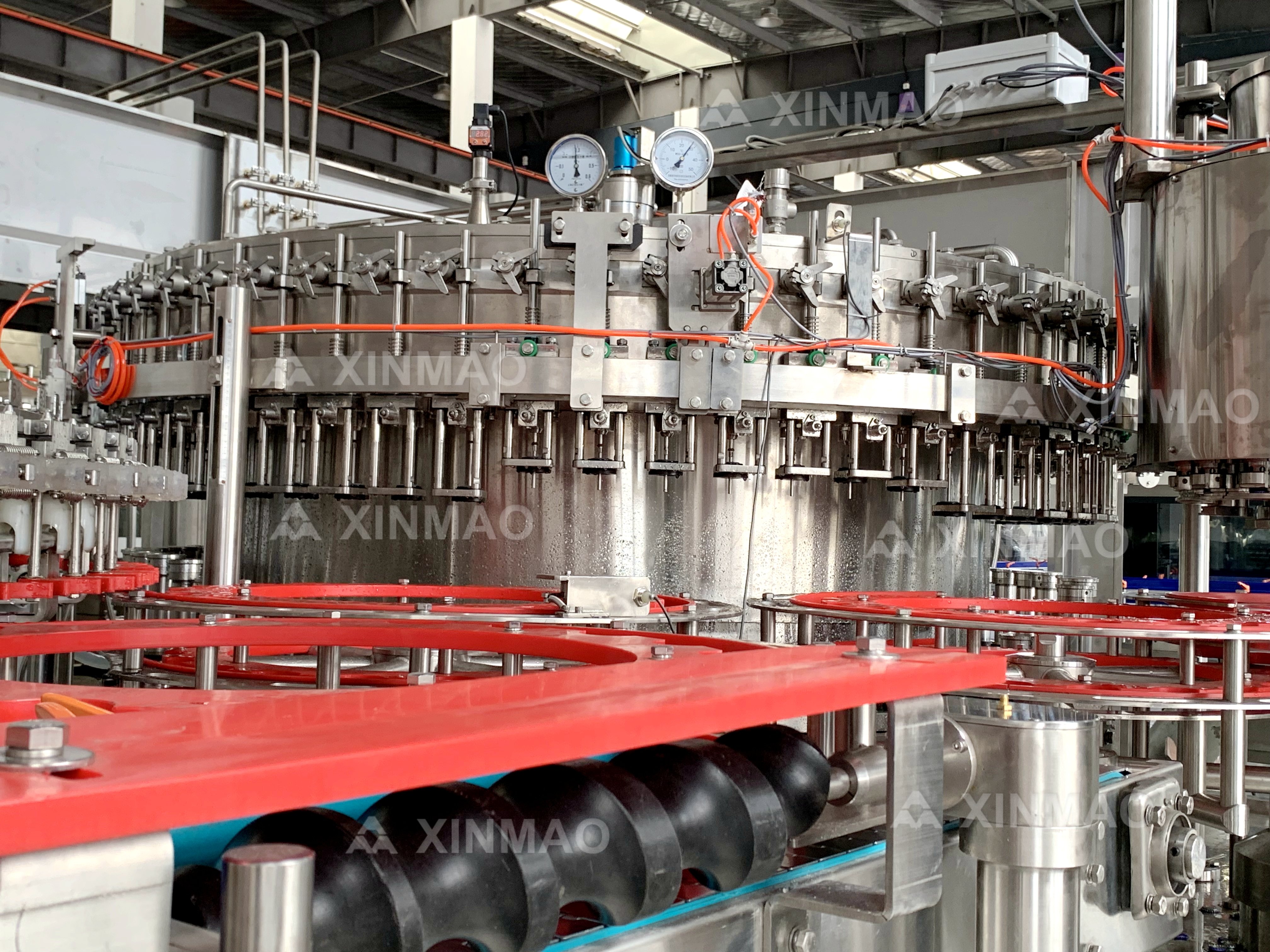
Carbonated soft drink making machines deploy either carbonation towers or inline micro-carbonation modules to dissolve CO₂ at precise ratios. Towers excel in high-throughput, steady-state environments—offering robust saturation control for large bottling lines—but their large liquid hold-up slows response to changes in syrup concentration, base temperature, or line speed. Inline micro-carbonation modules minimize residence time, enabling rapid startup and seamless recipe transitions, but demand tighter flow regulation to avoid under-carbonation or premature CO₂ breakout at the filler valve. The core trade-off is scale versus agility: tower systems suit stable, high-volume production; inline designs prioritize flexibility for lower-volume, frequent-changeover operations. Both rely on precision filling valves, hygienic sanitary pumps, and high-grade stainless steel or engineering polymers to limit wear, CO₂ leakage, and maintenance downtime. Critically, both architectures require smooth, nucleation-free internal surfaces—any micro-roughness or residue can trigger unwanted CO₂ release during filling.
Closed-Loop PID Control with Real-Time Pressure–Temperature Cross-Compensation
Stable carbonation relies on closed-loop PID (proportional–integral–derivative) control that continuously compares setpoint pressure, liquid temperature, and flow rate against real-time sensor feedback. The controller dynamically adjusts CO₂ injection and chiller output to enforce pressure–temperature cross-compensation—ensuring dissolved CO₂ remains within specification despite thermal or process fluctuations. When product temperature rises, the loop compensates by increasing back-pressure or lowering chilling setpoint to suppress CO₂ breakout and foaming. Given Henry’s Law’s near-linear pressure–solubility relationship, even a 0.1 bar deviation can shift carbonation by 0.08–0.12 volumes (Beverage Carbonation Data, 2026). High-precision systems sample sensors multiple times per second and tune PID gains to match piping dynamics and carbonator volume. Operators define upper/lower alarm thresholds; sustained deviations trigger automatic shutdown or batch diversion—protecting consistency without operator intervention.
Real-Time Monitoring and Calibration to Sustain CO₂ Ratio Consistency
In-Line CO₂ Sensors (NDIR/Conductivity) and Mitigating Calibration Drift
Consistent carbonation hinges on accurate, real-time CO₂ measurement—delivered every few seconds by in-line NDIR (Non-Dispersive Infrared) or conductivity sensors. NDIR probes detect dissolved CO₂ via infrared absorption; conductivity sensors infer carbonation from ion mobility shifts in carbonated liquid. Both are vulnerable to calibration drift caused by syrup fouling, thermal cycling, and membrane degradation. Modern systems mitigate this by cross-checking sensor output against a reference cell or known CO₂ partial pressure at the filler bowl—flagging deviations before they reach the fill valve. Automated zero-and-span calibration at shift start and after clean-in-place cycles further reduces drift. If readings exceed preset tolerance bands, the system blocks filling or initiates corrective pressure adjustments—maintaining carbonation ratio consistency without relying on manual lab sampling.
Brix–CO₂ Correlation Modeling to Compensate for Syrup Density Variability
Fixed CO₂ pressure settings fail when syrup concentration varies—leading to under- or over-carbonation and inconsistent mouthfeel. To prevent this, inline Brix meters or Coriolis mass flow sensors feed real-time dissolved-solids data to the carbonator controller. A validated correlation model converts Brix and temperature into the precise saturation pressure needed to achieve the target CO₂ volume. For example, higher-Brix syrup typically requires a modest pressure increase at a given temperature. The controller updates this target continuously within each batch, adapting to syrup batch variability and water mineral shifts. This dynamic Brix–CO₂ coupling corrects for drift that periodic manual checks would miss—ensuring reliable carbonation bite and sensory performance across production runs.
Preventive Maintenance Protocols for Stable CO₂ Delivery
A carbonated soft drink making machine depends on a tightly integrated CO₂ delivery loop: supply pressure, injection flow, and in-line sensing. Any drift in this chain alters final CO₂ ratio—even when recipes remain unchanged. Reactive maintenance costs three to nine times more than planned upkeep (Plant Engineering, 2026), and unplanned failures in the CO₂ path are among the top causes of carbonation inconsistency. Reliable operation therefore demands disciplined preventive maintenance—not emergency fixes.
| Interval | Component | Maintenance action | Impact on CO₂ ratio |
|---|---|---|---|
| Daily | CO₂ supply manifold | Check inlet pressure; inspect for frost or leaks | Prevents pressure swings that directly alter solubility |
| Weekly | Gas filter and regulator | Drain condensate; verify setpoint accuracy | Ensures stable, contamination-free injection pressure |
| Monthly | Carbonation tank or inline module | Clean diffusers and nozzles; test level sensors | Maintains uniform gas dispersion and dosing accuracy |
| Quarterly | In-line CO₂ sensors | Calibrate against a certified gas standard | Corrects drift that leads to systemic over- or under-carbonation |
| Semi-annual | Seals, gaskets, relief valves | Replace worn components; validate relief setpoints | Eliminates CO₂ leaks that erode saturation and waste gas |
Beyond scheduled tasks, operators must confirm CO₂ remains dry and free of oil or moisture—contaminants that foul regulators and NDIR sensors, causing silent, cumulative measurement errors. A documented lockout/tagout procedure for gas lines is essential for every shift handover. Logging inlet pressure, liquid temperature, and measured CO₂ volume after each batch builds a diagnostic baseline. For example, a 2–3°F rise in inlet water temperature often requires a 5–8 psi CO₂ pressure adjustment to hold carbonation steady. Maintenance logs linking gas delivery metrics to thermal conditions empower teams to identify and correct small deviations before entire batches fall out of specification.
FAQs
What is Henry’s Law and how does it affect CO₂ solubility?
Henry’s Law states that the amount of dissolved CO₂ in a liquid increases with higher pressure and decreases with rising temperature under constant pressure. Carbonated soft drink machines leverage this principle for consistent CO₂ saturation.
How does syrup concentration impact carbonation?
Higher syrup concentrations increase liquid density and viscosity, making it harder for CO₂ to dissolve. Machines dynamically adjust pressure and temperature to achieve the desired carbonation level.
What are the key differences between carbonation towers and inline micro-carbonation modules?
Carbonation towers are ideal for high-volume, steady production environments. Inline micro-carbonation modules provide greater flexibility for smaller batches and frequent recipe transitions, but require precise control to prevent CO₂ breakout.
Why is regular maintenance important for CO₂ delivery systems?
Preventive maintenance minimizes system drift and ensures consistent carbonation, reducing the risk of costly failures and unplanned downtime.
How does closed-loop PID control assist in carbonation consistency?
PID control continuously adjusts CO₂ injection, pressure, and temperature based on real-time sensor feedback to ensure precise carbonation despite fluctuations in process conditions.
Table of Contents
- Core Carbonation Physics: How CO₂ Solubility Dictates Machine Design
- Carbonated Soft Drink Making Machine Architecture for Precision Dosing
- Real-Time Monitoring and Calibration to Sustain CO₂ Ratio Consistency
- Preventive Maintenance Protocols for Stable CO₂ Delivery
-
FAQs
- What is Henry’s Law and how does it affect CO₂ solubility?
- How does syrup concentration impact carbonation?
- What are the key differences between carbonation towers and inline micro-carbonation modules?
- Why is regular maintenance important for CO₂ delivery systems?
- How does closed-loop PID control assist in carbonation consistency?