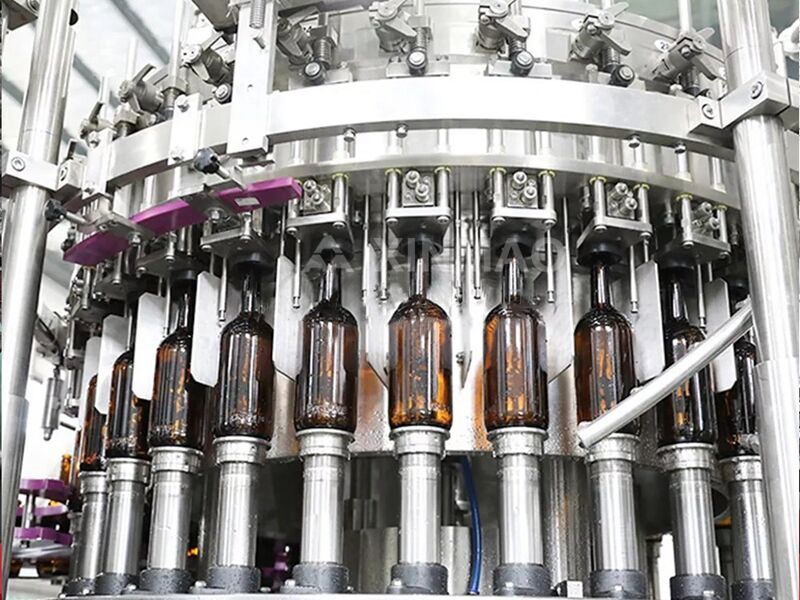
Why High-Capacity Beverage Filling Machines Are Essential for Modern Beverage Production
The beverage manufacturing sector is under immense pressure these days to produce huge quantities while still keeping quality standards high. High capacity filling systems tackle this problem head on, allowing plants to process thousands of containers each hour. This matters a lot for companies making bottled water or carbonated drinks since their ability to scale up production determines whether they stay competitive or fall behind. Automation cuts down on mistakes made by humans and saves money on labor expenses too. The engineering behind these systems keeps fill levels accurate within just half a percent across all sorts of packaging formats including glass bottles, aluminum cans, and cardboard cartons. Flexibility is just as important though. Modern equipment can handle everything from clear fruit juice to thick berry smoothies without missing a beat, which means less time wasted when switching products. And those few extra minutes really count. According to research from the Ponemon Institute in 2023, even short periods of downtime could cost a facility around $740,000 each year in missed sales opportunities. Given how slim profit margins already are and how unpredictable customer preferences can be, smart companies know that investing in good filling technology isn't something they can afford to ignore if they want long term success.
Quality Verification
Selecting the optimal beverage filling machine technology requires precise alignment with your product's physical properties and quality standards. Liquid characteristics directly determine which filling method delivers maximum accuracy while minimizing waste—a critical consideration when scaling production volumes.
Viscosity, Carbonation, and Pulp Handling: How Liquid Properties Dictate Filling Method Selection
The thickness of beverages plays a big role in determining which machines work best for them. Water and tea flow easily through gravity-fed or overflow systems, but thicker stuff like syrups and plant-based milks need specialized piston fillers because they just won't flow right otherwise. Sparkling drinks create their own set of problems with all that foam, so manufacturers typically use pressurized chambers during filling to keep the carbonation intact. Juice producers dealing with pulp content face another challenge altogether. Their nozzles have to be specially designed to stop clogs while still keeping those fruit particles suspended in the liquid. According to some industry reports, getting the viscosity wrong can lead to around 15% wasted product when systems aren't matched properly to the beverage being processed.
Overflow vs. Piston vs. Flow Meter Filling: Accuracy, Speed, and CO2 Integrity Trade-Offs
Each filling technology presents distinct operational trade-offs:
| Method | Accuracy | Speed | CO2 Retention | Best For |
|---|---|---|---|---|
| Overflow | ±1% | Moderate | Excellent | Carbonated drinks |
| Piston | ±0.5% | High | Poor | Viscous/pulpy beverages |
| Flow Meter | ±0.3% | Very High | Moderate | Non-carbonated precision fills |
Overflow systems are really good at keeping carbonation intact, though they tend to slow things down quite a bit when it comes to production speed. Piston fillers work great for viscous materials and can crank out product fast, but anyone who's dealt with delicate foamy drinks knows these machines just don't cut it for those kinds of products. Flow meters? They're absolutely fantastic for high value goods where precision matters most, but there's a catch - these devices need pretty consistent temperature conditions to stay properly calibrated. For plant supervisors, the big decision usually boils down to whether maintaining CO2 levels within about 2% variance is worth accepting lower output rates, or if pushing through 60 thousand units per hour takes precedence over perfect carbonation retention. Most facilities end up finding a middle ground somewhere between these extremes depending on what customers care about most.
Designing Scalable, High-Throughput Beverage Filling Lines
Modern beverage filling machine installations prioritize scalable throughput without compromising precision. As production volumes surge, manufacturers must optimize line architecture to eliminate bottlenecks while maintaining fill accuracy within ±0.5% tolerances across diverse container formats.
Rotary Fillers and Multi-Head Systems: Maximizing Output Without Sacrificing Precision
The high speed rotary fillers equipped with servo driven valves allow multiple containers to be processed at once. Take a 72 head system for instance it's capable of filling over 600 bottles per minute which is pretty impressive for most production lines. Getting accurate results really hinges on matching up the flow controls with the conveyor indexing system. When containers move too fast or slow during this process, the volume consistency starts to suffer. Speaking of specific applications, piston fillers work wonders for thicker substances like fruit pulp or fizzy beverages. These machines keep within about plus or minus 2 milliliters even while running through 400 cycles every minute. Anyone looking to set up their own bottling line should definitely pay attention to these kinds of technical details when choosing equipment configurations.
| Performance Metric | Entry-Level Range | High-Capacity Standard |
|---|---|---|
| Containers/Minute | 80–180 | 300–650 |
| Fill Volume Tolerance | ±1.5% | ±0.5% |
| Format Changeover | 25–40 minutes | 8–15 minutes |
Studies show 89% of large-scale producers require lines handling ≥5 container types (Material Flexibility Study, 2024). Modular rotary platforms achieve this through quick-release nozzles and programmable height adjustments accommodating 50–500 mm bottle heights.
Automation Integration and Labor Optimization in End-to-End Bottling Lines
When companies automate their bottle handling, filling, capping, and inspection processes, they typically see around a 70% drop in manual work needed. Labor costs go down significantly too, somewhere between $18 to maybe even $42 less per hour during each shift. The heart of this automation lies in those integrated PLC systems that match up conveyor belt speeds with the filler valves, keeping things moving at over 500 bottles per minute most of the time. Carbonated drinks require special attention since the fizz needs to stay consistent. That's why manufacturers install inline CO2 sensors along with pressure controlled fillers, which helps keep carbonation levels within about 1.5% difference across all products. And let's not forget about the vision guided rejection systems either. These clever machines scan through well over 200 units every minute looking for anything off about fill levels or damaged caps. All these interconnected control systems mean steady production without those expensive stoppages that happen when someone has to manually adjust something on the line.
Avoiding Common Pitfalls: Balancing Speed, Accuracy, and Maintenance in High-Capacity Operations
High-volume beverage filling operations face critical trade-offs: prioritizing throughput over precision risks fill-level inconsistencies and product waste, while neglecting maintenance triggers catastrophic downtime costing facilities up to $250k/hour (Industry Report, 2024). Overemphasizing speed amplifies three key failure points:
- Calibration drift from vibration stress during rapid cycles
- Seal degradation accelerating under continuous high-pressure operation
- Sensor fouling causing inaccurate volume measurements
To sustain peak performance without compromising quality:
- Implement predictive maintenance protocols using IoT vibration sensors, reducing unplanned downtime by 30%
- Schedule automated Clean-in-Place (CIP) cycles between runs to prevent residue buildup
- Conduct real-time pressure monitoring to maintain carbonation integrity
Balancing these elements requires aligning machine capabilities with output targets—volumetric piston fillers maintain ±0.5% accuracy at 600 BPM, while overflow systems achieve 800+ BPM but vary ±1.5%. Proactive thermal compensation for viscosity shifts and laser-guided container positioning further optimize precision.
Ultimately, sustained efficiency in beverage filling machine operations hinges on integrated analytics that forecast maintenance needs before failures occur, transforming reactive fixes into strategic optimization.
FAQ
What are the main types of beverage filling technologies?
The main types are overflow, piston, and flow meter filling technologies, each with its own operational advantages based on accuracy, speed, and suitability for different beverage types.
Why is flexibility important for filling machines?
Flexibility allows machines to handle various beverage types and packaging formats, reducing downtime and enhancing productivity.
How can companies avoid common pitfalls in high-capacity operations?
By focusing on predictive maintenance, automated cleaning cycles, and real-time pressure monitoring to sustain peak performance and minimize downtime.
How does automation impact labor costs and efficiency?
Automation significantly reduces manual labor by around 70%, cutting labor costs and enhancing production efficiency.