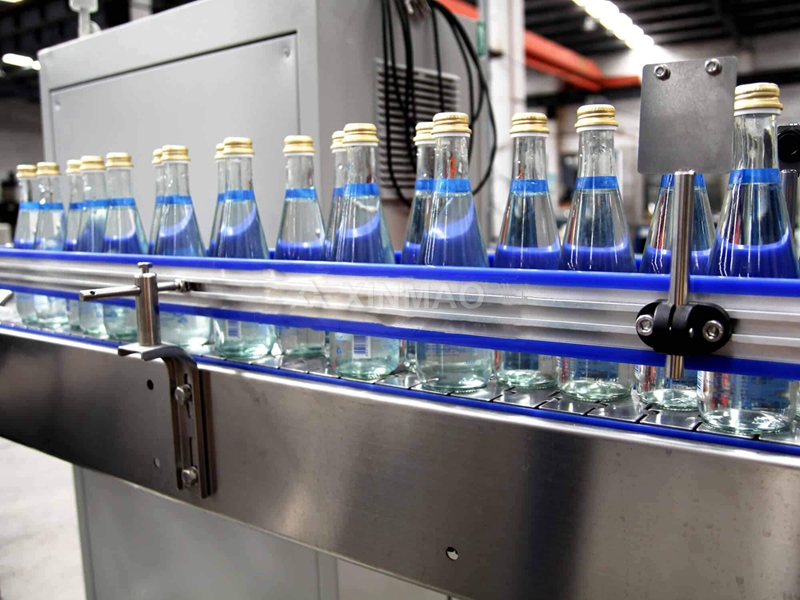
High-Speed Filling Technology: Core Enabler of High-Volume Output
Modern water bottle machines leverage high-speed filling technology to meet demanding production schedules. Leading manufacturers achieve outputs exceeding 15,000 bottles per hour using advanced rotary systems—demonstrating how precision engineering directly supports large-scale consumer demand without sacrificing operational efficiency.
Rotary Servo-Driven Filling Modules for Precision and Consistency
Servo-driven rotary filling heads deliver volumetric accuracy within ±0.5% tolerance—even at peak speeds—by combining multi-nozzle carousels for stable bottle alignment, direct-drive servo motors that eliminate mechanical backlash, and real-time pressure compensation that adapts to viscosity fluctuations during continuous operation. High-precision sensors ensure consistent fill levels across 24-hour production cycles, reducing product giveaway by up to 2.7% compared to conventional systems (GST Automation 2024). This stability is essential for maintaining quality control in high-volume environments.
PLC/HMI Integration for Real-Time Speed Adjustment and Diagnostics
Programmable Logic Controllers (PLCs) and Human-Machine Interfaces (HMIs) unify rinsing, filling, capping, and labeling operations under centralized, real-time control. This enables instantaneous speed synchronization across all stations, predictive diagnostics that flag potential failures before downtime occurs, and automated data logging for OEE optimization.
| Control Feature | Function | Impact on Production |
|---|---|---|
| Speed Synchronization | Matches conveyor velocity with filling cycles | Prevents bottle jams at 200+ bottles/minute |
| Auto-Calibration | Adjusts fill parameters for different bottle sizes | Reduces changeover time to <5 minutes |
| Fault Tracing | Pinpoints component-level errors | Cuts diagnostic time by 70% |
Intuitive touchscreen interfaces allow operators to switch between product formats while sustaining 98% line efficiency—transforming raw speed into controllable, reliable throughput.
Fully Integrated In-Line Architecture for Bottling Efficiency
Synchronized Rinsing, Filling, Capping, and Labeling in One Water Bottle Machine
A single water bottle machine now integrates rinsing, filling, capping, and labeling into one seamless, servo-synchronized flow. Eliminating inter-station transfers and conveyor bottlenecks, this architecture reduces cycle time by up to 20%, minimizes product waste, and lowers contamination risk. A central PLC dynamically adjusts timing across all stages when line speed changes—ensuring uninterrupted movement of every bottle and supporting consistent throughput at scale.
AI Vision Inspection Aligned with Line Speed to Maintain Zero-Defect Output
AI-powered vision inspection operates in real time at full line speed—scanning fill level, cap torque, and label alignment as each bottle passes through. Trained to distinguish normal variation from true defects, the system triggers millisecond-accurate rejections when anomalies occur. Tight integration with production logic ensures zero-defect output without compromising throughput, replacing manual sampling with continuous, shift-independent quality assurance.
Scalable Design and Operational Reliability for Sustained High Volume
Modular Water Bottle Machine Framework Supporting Future Capacity Expansion
Scalability is built into the machine’s modular framework—enabling manufacturers to add or reconfigure filling stations, capping units, or labeling modules as demand grows. This design protects initial investment while allowing capacity to scale smoothly from thousands to tens of thousands of bottles per hour. Industry analysis confirms that such foresight avoids unplanned downtime associated with retrofits, delivering measurable cost savings over the equipment lifecycle.
Rapid Changeover Systems (<15 Minutes) Across Bottle Sizes and Formats
Modern water bottle machines support full format changes—including bottle size, shape, and cap type—in under 15 minutes. Servo-driven adjustments and tool-less change parts eliminate manual recalibration, significantly reducing transition time. This agility directly improves OEE by minimizing lost output during changeovers and enabling responsive, profitable production scheduling.
Energy Efficiency, Hygiene Compliance, and OEE Optimization
Sustainable high-volume bottling rests on three interdependent pillars: energy efficiency, hygiene compliance, and OEE optimization. Variable frequency drives and regenerative braking cut energy use by up to 30% versus conventional models—lowering cost per unit and environmental impact. Stainless-steel construction with crevice-free surfaces and fully automated clean-in-place (CIP) systems ensure ongoing compliance with FDA and ISO 22000 standards, mitigating bacterial contamination risks during extended runs. Meanwhile, real-time OEE monitoring—tracking availability, performance, and quality—enables proactive intervention against micro-stoppages and minor stops. Top-performing facilities sustain OEE scores above 85% by leveraging these integrated capabilities, balancing maximum output with regulatory rigor and responsible resource use.
FAQs
What is OEE optimization in water bottling machines?
OEE (Overall Equipment Effectiveness) optimization involves monitoring and improving the availability, performance, and quality of production processes to maximize line efficiency and output.
Why is AI-powered vision inspection important?
AI-powered vision systems ensure zero-defect output by identifying and rejecting bottles with anomalies such as incorrect fill levels, improper cap torque, or misaligned labels—without disrupting production speed.
How does modular design benefit water bottle machines?
Modular designs allow scalability by enabling manufacturers to add or reconfigure modules like filling stations or capping units as production demands grow, reducing downtime and future retrofit costs.
What are clean-in-place (CIP) systems?
CIP systems automate the cleaning process in bottling machines, maintaining hygiene standards and reducing risks of contamination during extended production runs.