Throughput and Production Speed: Linear vs. Rotary Bottling Machine Performance
Bottles Per Minute (BPM) Benchmarks and Real-World Output Ranges
Linear bottling machines typically operate at 300–800 bottles per minute (BPM). Their discontinuous, start-stop motion—pausing between cycles to position containers—makes them well-suited for small-batch production and frequent product or container changeovers. This range supports moderate-volume operations for craft beverage makers, specialty food producers, and pharmaceutical manufacturers without requiring heavy capital investment.
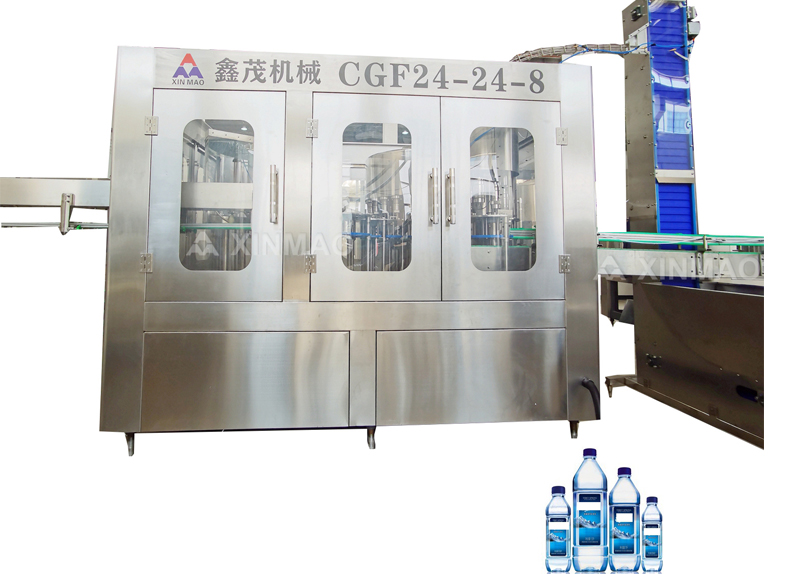
Rotary bottling machines deliver continuous, high-speed operation—typically 800–2,000+ BPM—by filling containers on a rotating carousel. This eliminates the mechanical inefficiencies inherent in linear indexing, enabling consistent throughput ideal for carbonated soft drinks, water, and other high-demand beverages scaling to national or global distribution.
When Rotary Bottling Machines Scale Beyond 10,000 BPH
Rotary systems become the practical standard for facilities producing over 10,000 bottles per hour (BPH). Their multi-head architecture—commonly featuring 20 to 50 synchronized filling stations—leverages parallel processing to sustain volume while maintaining precision. Large-scale beverage plants rely on this design for extended mass-production runs, where floor-space efficiency and output consistency are critical.
Linear machines rarely exceed 48,000 BPH (800 BPM) due to inherent mechanical limitations of intermittent motion. At higher volumes, acceleration/deceleration cycles create bottlenecks and increase wear. By comparison, a rotary machine running at 1,200 BPM achieves 72,000 BPH—50% greater output than the linear ceiling—making it the preferred choice for high-volume manufacturing where throughput directly impacts capacity utilization and cost-per-unit.
Footprint, Layout, and Facility Integration Requirements
Selecting bottling equipment demands careful evaluation of spatial requirements—not just physical dimensions, but how layout affects material flow, service access, scalability, and integration with existing infrastructure.
Linear Bottling Machine Layouts: Simplicity and Modularity
Linear machines use an in-line, sequential configuration that simplifies installation, operator oversight, and material handling. Their modular construction allows straightforward expansion—adding filling heads, rinsers, or conveyors usually involves extending the line rather than reengineering the entire footprint. This modularity supports phased growth and retrofitting into older facilities. Maintenance is generally more accessible thanks to unobstructed side and top access to components, and operators benefit from intuitive visual monitoring along the production path.
Rotary Bottling Machine Spatial Demands and Circular Flow Constraints
Rotary machines occupy a compact circular footprint centered around a rotating carousel—but demand precise spatial planning. The system requires radial clearance for full rotation, plus tangential alignment of feed and discharge conveyors to maintain smooth product transfer. Unlike linear layouts, post-installation modifications are limited by the fixed geometry of the carousel base. Service access must be engineered into the design—especially around timing screws, starwheels, and drive enclosures—to avoid compromising uptime during routine maintenance or sanitation.
Changeover Flexibility and Line Integration Capabilities
Container Changeovers: Speed and Tooling Complexity by Bottling Machine Type
Changeover speed significantly influences Overall Equipment Effectiveness (OEE). Linear machines excel here: their modular architecture enables rapid adjustments to conveyor guides, nozzle heights, and fill volumes via manual or servo-driven controls. Tool-less or low-tool kits often reduce format changes to under 15 minutes—even across varying bottle sizes and shapes. Rotary machines involve more complex mechanical synchronization across multiple stations—starwheels, capping heads, timing screws—so full changeovers historically required 45–90 minutes. However, modern servo-controlled rotary platforms now support recipe-based auto-repositioning, substantially narrowing the flexibility gap. For facilities managing dozens of SKUs in short batches, linear systems minimize downtime and labor overhead. For long-run, high-speed operations, the rotary’s throughput advantage outweighs longer initial setup time once optimized.
CIP/SIP Compatibility and Seamless Integration with Packaging Lines
Clean-in-place (CIP) and sterilize-in-place (SIP) compliance is mandatory in food, beverage, and pharmaceutical applications. Linear machines offer inherently simpler CIP routing: straight-line station layouts allow direct access to nozzles, valves, and product-contact surfaces, enabling fully automated cleaning cycles without disassembly. Many models include integrated spray balls and gravity-drain paths validated to FDA and 3-A Sanitary Standards.
Rotary systems require more sophisticated CIP engineering—including rotating unions, manifold manifolds, and balanced fluid distribution—to ensure uniform coverage across all filling heads. Yet leading rotary platforms now meet the same regulatory benchmarks, delivering validated cleaning performance and cycle times comparable to linear alternatives.
Both machine types integrate seamlessly with upstream rinsers and downstream cappers, labelers, and case packers via standardized conveyor interfaces and PLC-level communication (e.g., EtherNet/IP or PROFINET). The key distinction lies in alignment: linear lines simplify mechanical synchronization, while rotary installations demand precise timing coordination with adjacent equipment to prevent jams or misfeeds.
Total Cost of Ownership: Investment, Maintenance, and Operational Economics
A bottling machine’s purchase price reflects only part of its financial impact. Total Cost of Ownership (TCO) encompasses acquisition, energy use, preventive and corrective maintenance, spare parts availability, technician training, sanitation labor, and end-of-life disposal. While linear machines carry lower upfront costs, their slower throughput can inflate per-unit labor and facility overhead—especially as demand grows. Rotary systems command higher initial investment and specialized maintenance expertise, but deliver superior operational economics at scale: lower energy consumption per bottle, reduced maintenance frequency relative to output, and better amortization of labor and floor space. Factoring in real-world reliability data from manufacturers like Krones, Bosch Packaging, and Coesia—and aligning with your production profile—ensures the TCO model reflects not just equipment cost, but long-term business performance.
FAQ
Which bottling machine is better for small-scale production?
Linear bottling machines are ideal for small-scale production due to their modular design, lower upfront costs, and faster changeover capabilities. They excel in frequent product or container changeovers and are well-suited for craft beverage makers and specialty producers.
What throughput can rotary bottling machines achieve?
Rotary bottling machines can achieve throughput ranging from 800 BPM to over 2,000 BPM, making them suitable for high-demand, large-scale production facilities.
Are rotary bottling machines harder to maintain?
Rotary bottling machines require more precise maintenance due to their complex components, such as timing screws and starwheels. However, leading models are engineered for efficient cleaning and synchronization, reducing downtime.
How does Total Cost of Ownership differ between linear and rotary bottling machines?
Linear machines have lower upfront costs but may carry higher per-unit overhead at larger scales. Rotary machines offer better operational economics over time, with higher throughput, reduced energy consumption per unit, and efficient space utilization.
How do CIP and SIP systems compare in linear and rotary machines?
Linear machines provide simpler CIP/SIP routing due to straightforward layouts, while rotary systems require advanced engineering for uniform cleaning but meet comparable sanitation standards.
Table of Contents
- Throughput and Production Speed: Linear vs. Rotary Bottling Machine Performance
- Footprint, Layout, and Facility Integration Requirements
- Changeover Flexibility and Line Integration Capabilities
- Total Cost of Ownership: Investment, Maintenance, and Operational Economics
-
FAQ
- Which bottling machine is better for small-scale production?
- What throughput can rotary bottling machines achieve?
- Are rotary bottling machines harder to maintain?
- How does Total Cost of Ownership differ between linear and rotary bottling machines?
- How do CIP and SIP systems compare in linear and rotary machines?