
Upfront Investment and Time-to-Production ROI
Capital Expenditure Comparison: Turnkey Water Bottling Line vs. Modular Procurement
A detailed capital layout reveals that while a turnkey water bottling line often carries a higher sticker price, modular procurement masks significant hidden charges. The table below breaks down the differences.
| Cost Element | Turnkey Water Bottling Line | Modular Procurement |
|---|---|---|
| Equipment Purchase | Single, bundled quote covering all machines | Sum of individual machine quotes, often 10–15% lower nominally |
| System Integration & Engineering | Included in contract; vendor‑managed | Requires separate engineering, typically 20–30% of total equipment cost |
| Installation & Commissioning | Coordinated, accelerated, and covered under one agreement | Multiple vendor schedules, owner‑managed, adding 5–10% to cost |
| Total Upfront Outlay | Often 12–18% higher at first glance | Appears cheaper, but true cost emerges after integration fees |
Industry surveys indicate that modular setups can overshoot initial estimates by 18–25% once integration is fully accounted for (Packaging Digest). The turnkey approach consolidates these expenses, giving an all‑in figure that avoids surprise costs and enables precise capital planning.
Hidden Integration Costs: Engineering, PLC Rewiring, and Validation Delays
Beyond equipment pricing, the most damaging expenses lurk in the gaps between separately sourced machines. Each distinct supplier introduces interface points that demand custom engineering. Reprogramming PLCs to synchronize a filler from one manufacturer with a capper from another typically consumes 150–200 engineering hours per link—translating to $18,000–$28,000 in labor alone. A standard water bottling line involves at least three such critical handshakes.
Moreover, validation protocols—especially for FDA‑regulated processes—require far more time when components come from different vendors. A single‑source line arrives with pre‑validated interoperability; a modular build forces operators to prove each connection separately. Studies show that integration and validation can consume 25–35% of the total project budget in modular scenarios (ISA). These overheads quickly erode any initial purchase savings, turning a seemingly economical choice into a costly, drawn‑out deployment.
Accelerated Time-to-Revenue: 4–6 Months Faster Launch with Turnkey Water Bottling Line
Speed to market directly affects ROI, and a turnkey water bottling line compresses the typical launch timeline by four to six months. The single‑supplier model eliminates back‑and‑forth coordination between multiple vendors, removes the need for on‑site interface coding, and delivers a fully‑tested system that starts production weeks after installation. In contrast, modular projects often stall during integration: each delay in PLC tweaks or parts alignment postpones revenue generation. For a mid‑volume line, each lost month can equate to $150,000–$250,000 in unrealized sales. By shipping to customers sooner, the turnkey solution begins recouping its investment while modular setups are still debugging. This head start not only boosts cash flow but also secures market share before competitors react.
Operational ROI: Uptime, Maintenance, and Lifecycle Efficiency
Operational continuity is the engine of long-term profitability for any water bottling line. While upfront costs capture initial attention, the persistent drag of unplanned downtime and fragmented maintenance consistently erodes margins. The true return on investment emerges when the system achieves peak throughput consistently—not sporadically.
OEE Gains from Vendor-Validated Interoperability in a Turnkey Water Bottling Line
Equipment interoperability directly dictates Overall Equipment Effectiveness (OEE). In a modular setup, the filler, capper, and labeler each operate with independent control logic. These subtle timing mismatches between stations can force a high-speed line to run below its rated capacity to avoid jams—a 1–5% performance loss confirmed by packaging line audits.
A turnkey water bottling line eliminates this compromise. The engineering team pre-validates communication between a servo-driven filler and a rotary capper to ensure mechanical actions are perfectly synchronized. This prevents cascading errors—like a bottle backlog triggering a photo-eye, which pauses the infeed screw and starves the filler—reducing output by hundreds of units per hour. A unified controls architecture also enables dynamic line balancing, where machine speed adjusts in real time to available containers rather than relying on discrete sensors. This closed-loop feedback stabilizes throughput and directly improves the availability metric of the OEE score.
Single-Point Accountability: Spare Parts Consolidation and Training Efficiency
Maintenance strategy determines whether a water bottling line is a cost center or a profit engine. Choosing between integrated and fragmented support creates two very different operational realities.
| Operational Dimension | Integrated Turnkey Support | Fragmented Modular Support |
|---|---|---|
| Spare Parts Inventory | Managed through a single bill of materials with consolidated critical spares, reducing duplicate safety stock by up to 20%. | Requires separate vendor inventories, often leading to overstocking identical pneumatic cylinders or sensors under different part numbers. |
| Troubleshooting Workflow | One service team diagnoses the root cause across the electrical, pneumatic, and software layers without blaming adjacent modules. | Multiple hotlines waste production time as mechanical and controls vendors each prove their module is not the failure source. |
| Technician Training Investment | A single human-machine interface standard reduces operator learning curve by 30–40%, enabling faster skill transfer across the entire line. | Maintenance teams must master disparate interfaces, increasing reliance on specialized contractors and inflating long-term service costs. |
Single-point accountability transforms the reaction to a line stop. Instead of costly diagnostic delays while multiple suppliers exchange reports, a single support contract guarantees a target Mean Time to Repair (MTTR), often covering the entire mechanical and controls stack—channeling maintenance budgets toward predictable prevention instead of emergency freight charges.
Compliance, Risk, and Scalability ROI
FDA/ISO 22000 Compliance Burden Reduction with Turnkey Water Bottling Line Deployment
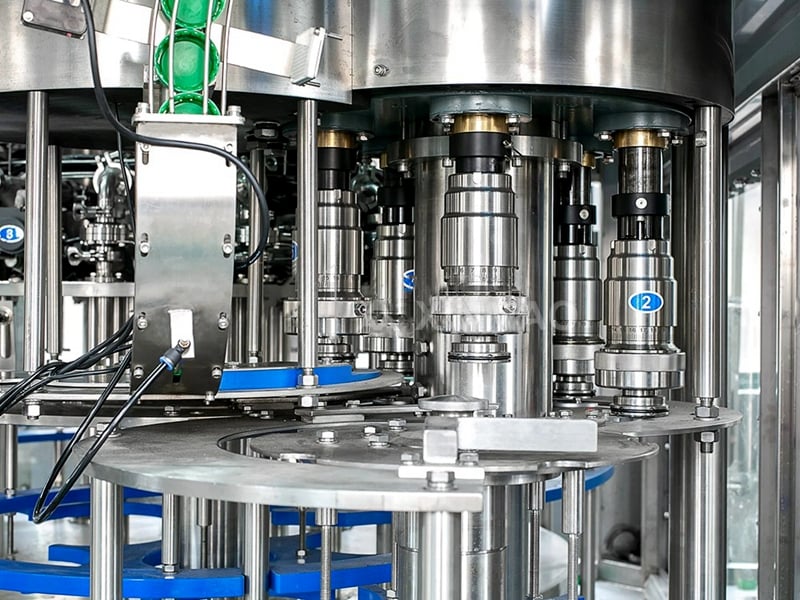
Achieving and maintaining FDA and ISO 22000 certification for a new water bottling line demands rigorous documentation, validated cleaning protocols, and traceability systems. A turnkey integration shifts this burden from the buyer to a single vendor‑accountable provider. The system arrives with pre‑validated sanitary welds, CIP (Clean‑in‑Place) sequences, and material certificates that satisfy regulatory auditors from day one. In contrast, piecing together fillers, cappers, and conveyors from multiple manufacturers creates cross‑vendor validation gaps, often extending the compliance audit timeline by 6–8 weeks. Non‑compliance risks are real: a single FDA warning letter can halt production, costing upwards of $30,000 per day in lost output (industry average). By embedding compliance into the engineering phase—rather than retrofitting it after installation—turnkey water bottling line projects reduce regulatory risk and deliver a measurable quality‑assurance ROI.
Warranty Coverage and Future-Proof Scalability of Integrated Systems
A turnkey water bottling line typically carries a unified warranty, eliminating finger‑pointing between component suppliers when a fault occurs. This single‑point accountability accelerates resolution and keeps mean time to repair under 4 hours. Moreover, integrated architectures are designed with modular expansion in mind: a line can later incorporate high‑speed labelers or robotic palletizers without PLC re‑engineering. That inherent scalability protects the initial capital investment, allowing capacity to grow in step with market demand while retaining full vendor support continuity.
When Modular Sourcing Maximizes ROI for Specialized Needs
A modular procurement strategy delivers higher returns when production requirements are highly specialized or demand unpredictable. For niche water bottling line applications—such as glass packaging or cold-aseptic filling—sourcing individual best-of-breed machines allows precise specification matching, avoiding the over‑engineering common in turnkey packages. This approach converts upfront capital expenditure into a phased investment model: companies can deploy core equipment first, build operational experience, and add modules as market volumes grow, reducing initial financial risk. Modular designs also simplify future scalability; individual components can be upgraded instead of replacing entire lines, protecting long‑term asset value. In rapidly evolving segments, the ability to independently source advanced labelling or inspection units from specialists ensures the operation stays competitive without overhauling the whole system—ultimately optimizing ROI for high‑mix, low‑volume production scenarios.
FAQs
What is the key difference between turnkey and modular water bottling lines?
Turnkey lines provide a single, integrated solution managed by one vendor. Modular setups involve separately sourced components that require custom integration.
What are the hidden costs associated with modular water bottling lines?
Hidden costs include engineering for system integration, reprogramming PLCs, and extended validation and compliance processes.
How does a turnkey water bottling line benefit time-to-market?
Turnkey solutions reduce launch times by 4–6 months by eliminating vendor coordination and delivering a pre-tested, ready-to-run system.
Why is OEE higher in turnkey systems?
Pre-validated interoperability and unified controls in turnkey solutions ensure smoother operations and prevent downtime, leading to better OEE.
When is modular sourcing more advantageous?
Modular sourcing is ideal for specialized or niche production needs where precise machine specifications are required or in rapidly evolving production markets.