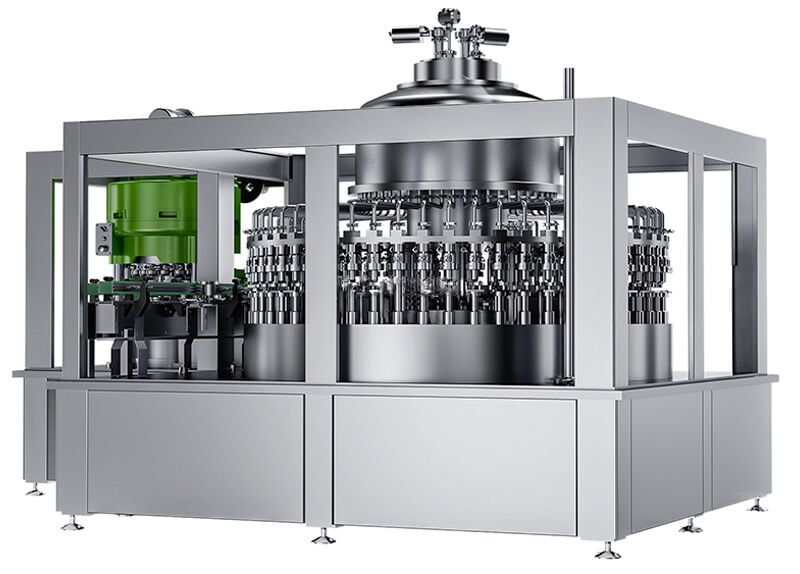
Why Syrup Residues Are a Unique Cleaning Challenge
The syrup used in carbonated beverages — typically a concentrated blend of sucrose or high-fructose corn syrup, flavor compounds, and preservatives — behaves differently inside a carbonated drink filling machine than other liquid products. Syrup is viscous, adhesive, and thermally sensitive. It clings to filling nozzles, accumulates inside transfer pipes at bends and gaskets, and caramelizes when exposed to residual heat from the filling head after production stops. Water-based products rinse away with a warm-water flush; syrup requires a multi-stage chemical protocol to fully remove.
Sugar Caramelization, Biofilm Formation, and Cross-Batch Contamination
When syrup residues remain inside a carbonated drink filling machine after an incomplete cleaning cycle, three things happen. First, residual sugars exposed to ambient heat from pump motors or sterilizing tunnels gradually caramelize into a hardened, dark-brown deposit that mechanically obstructs filling valves and alters flow rate calibration. Second, syrup residues — even after visual inspection appears clean — provide a nutrient substrate for biofilm-forming bacteria, including strains that survive standard sanitizer concentrations when protected within a biofilm matrix. Third, flavor carry-over occurs when traces of cola syrup from the previous batch contaminate a lemon-lime run, producing off-taste complaints. A beverage co-packer in Southeast Asia lost a major brand contract after citrus-soda bottles from a shared carbonated drink filling machine line tested positive for cola flavor compounds at 12 ppm — detectable by consumers and unacceptable to the brand owner. The root cause was a CIP cycle shortened from 45 to 28 minutes to increase daily throughput. XINMAO Machinery, a beverage filling equipment manufacturer since 2005 with ISO 9001 and CE certification, engineers its filling lines with dedicated CIP spray-ball positioning and sanitary-grade 304/316L stainless steel contact surfaces to minimize residue adhesion and simplify complete cleaning.
CIP Protocol for Syrup-Contact Surfaces
Pre-Rinse, Caustic Wash, Acid Rinse, and Sanitization Cycle
An effective CIP cycle for a carbonated drink filling machine that handles syrup follows four mandatory stages. Stage one — ambient-temperature pre-rinse with filtered water at 2.0 to 2.5 bar pressure for 10 to 15 minutes — removes 85% to 90% of bulk syrup residues before chemical application, preventing chemical consumption by residual sugars. Stage two — caustic wash with 1.5% to 2.0% sodium hydroxide solution at 70°C to 80°C, circulated for 20 to 30 minutes — saponifies fats from flavor oils and dissolves sugar polymers. Sodium hydroxide concentration must be verified by titration at the start and midpoint of the cycle; dropping below 1.0% renders the wash ineffective. Stage three — acid rinse with 0.5% to 1.0% nitric acid or phosphoric acid at 50°C to 60°C for 10 to 15 minutes — neutralizes residual caustic, removes mineral scale, and passivates stainless steel surfaces. Stage four — final sanitization with peracetic acid at 150 to 300 ppm or hot water at 85°C+ for a minimum 15-minute contact time.
Manual Cleaning for Inaccessible Zones
Disassembly Targets, Brush Selection, and Visual Inspection Criteria
CIP cannot reach every surface inside a carbonated drink filling machine. Filling valve gaskets, O-ring grooves, vent tubes, and rotary joint seals are dead-leg zones where syrup accumulates regardless of CIP circulation pressure. These components must be manually disassembled on a scheduled frequency — weekly for high-sugar products, biweekly for sugar-free lines. Use nylon-bristle brushes, never steel, to avoid scratching 316L stainless surfaces; scratches create micro-crevices where biofilm evades sanitizer. After manual cleaning, inspect under 500-lux white light with a borescope for gasket grooves and vent-tube interiors. Any amber-colored deposit, even a thin film, indicates incomplete cleaning. Reassemble with food-grade lubricant applied only to specified points — excess lubricant traps syrup dust from the production environment.
Validation and Preventative Scheduling
ATP Swab Testing, Rinse-Water Conductivity, and Cleaning Log Compliance
Cleaning a carbonated drink filling machine is not validated by the absence of visible residue. ATP (adenosine triphosphate) bioluminescence swab testing on 10 to 15 designated critical control points after cleaning provides a quantitative result in 15 seconds. A reading below 10 RLU (relative light units) on a standard ATP meter confirms no organic residue — sugar, protein, or microbial cells — remains. Readings between 10 and 30 RLU require re-cleaning that zone; above 30 RLU requires disassembly and manual scrubbing. Final rinse-water conductivity should match the incoming water supply within ±5 µS/cm; higher values indicate residual cleaning chemicals. Every cleaning cycle — CIP or manual — must be logged with operator initials, chemical concentration readings, cycle duration, ATP results, and any deviations with corrective actions recorded. Regulatory auditors, including those enforcing FDA 21 CFR Part 110 and EU Regulation 852/2004, review these logs during hygiene inspections.
Frequently Asked Questions
How often should a carbonated drink filling machine be cleaned?
A carbonated drink filling machine running syrup-based products requires full CIP after every production batch and a complete manual disassembly cleaning weekly. Skipping even one CIP cycle risks biofilm establishment. XINMAO provides cleaning protocol documentation with every machine installation.
What chemicals are needed to clean syrup from a filling machine?
Sodium hydroxide (1.5-2.0%) for organic residue breakdown, nitric or phosphoric acid (0.5-1.0%) for scale removal, and peracetic acid (150-300 ppm) for final sanitization. Chemical concentrations must be verified by titration mid-cycle.
Can CIP alone clean every surface of a filling machine?
No. Dead-leg zones — gasket grooves, vent tubes, rotary seals — inside a carbonated drink filling machine require weekly manual disassembly and brush cleaning. CIP cannot achieve sufficient turbulence in these areas.
How is cleaning effectiveness verified on a filling machine?
ATP bioluminescence swabbing on critical control points provides quantitative organic-residue detection in seconds. Below 10 RLU is clean. Rinse-water conductivity should match supply water within ±5 µS/cm.
What happens if syrup residue is left in a filling machine?
Residual syrup in a carbonated drink filling machine caramelizes into hardened deposits that obstruct valves, feeds biofilm-forming bacteria, and causes cross-batch flavor contamination detectable by consumers at concentrations as low as 10 ppm.
What material is best for syrup-contact surfaces in filling machines?
316L stainless steel with electropolished finish (Ra ≤0.8 µm) provides the best syrup-release properties in a carbonated drink filling machine. 304 stainless is acceptable but more susceptible to chloride pitting from acid cleaning cycles over time.